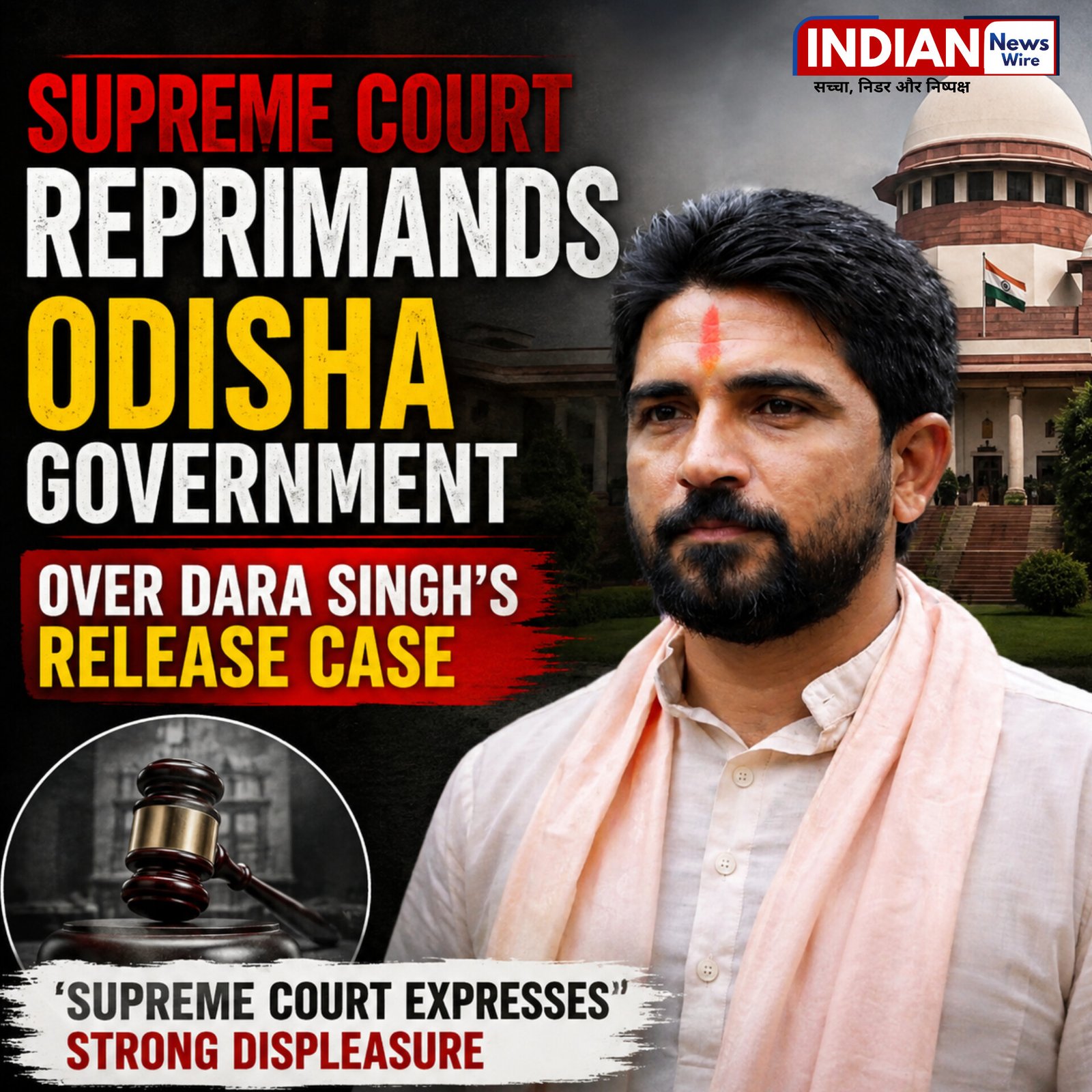
In the previous hearing, the Supreme Court had asked the Odisha government to decide on the release by August 19. However, a bench comprising Justices Manoj Mishra and Vijay Bishnoi was informed that no decision has been taken so far. The petitioner's lawyer initially sought time, but when the court asked why it was not taking a decision, he presented a letter from the Directorate General of Prisons. The Supreme Court had questioned why the letter was issued when the decision of the Review Board was required.
The lawyer said that the DG Police had stated that information related to Dara Singh's previous criminal record had been sought from his native Uttar Pradesh.
Justice Mishra had verbally said that the court would not accept such a delay. He directed the Review Board to decide on his application by September 2, failing which the court would take the decision itself. He said, "Take whatever decision you want, or we will take the decision... We do not care how you communicate, just take a decision. We cannot tolerate any delay in taking a decision."
The court ordered, "This matter has been repeatedly adjourned to enable the respondents to decide on the remission application of the appellant who has been in jail for more than 26 years.
The last time the matter was adjourned, the Sentence Review Board was in the process of deciding the appellant's application. On that basis, the matter was adjourned. Today, the respondent's counsel has placed before us a letter from the Directorate of Prisons and Correctional Services. The letter states that the report is awaited from the Keonjhar District Jail. We have not been informed about the decision of the Sentence Review Board. Let the matter be listed on September 2. Let the Sentence Review Board take a decision and inform us."
Convict Dara Singh has pleaded for remission of his sentence and stated that he has already spent more than 25 years in jail. According to the state's remission policy, convicts whose death sentences have been commuted to life imprisonment can be considered for remission after completing 25 years of their jail term.
The lower court had awarded death sentence to Dara Singh in 2003. In 2005, the Orissa High Court commuted the death sentence to life imprisonment. The Supreme Court upheld the sentence in 2011. In his writ petition filed by lawyers Hari Shankar Jain and Vishnu Shankar Jain, Dara Singh has stated that he committed the crime in the anger of his youth and that he is now remorseful for his actions.
Dara Singh has pleaded for early release on the basis of the reformative theory of punishment, so that he can return to society as a good person. He has cited the Supreme Court's 2022 verdict on early release of convicts convicted in the Rajiv Gandhi assassination case.
It is worth mentioning that this crime took place on January 22, 1999 in Manoharpur village of Keonjhar district of Odisha. A mob led by Dara Singh set fire to Graham Staines' car. Staines and his two sons Philip (10 years old) and Timothy (6 years old) were sleeping inside the car at that time.

Discussion